
What Happens During a Home Appraisal in Utah?
You've found the house.
Your offer has been accepted.
You've made it through inspections.
And then your lender tells you it's time for the appraisal.
For many home buyers, this is one of those parts of the transaction that happens mostly behind the scenes. You know someone is going to look at the house, but what exactly are they looking for? Who orders the appraisal? And what happens if the home doesn't appraise for the purchase price?
If you're buying or selling a home in Utah, here's what you need to know about the appraisal process.
What Is a Home Appraisal?
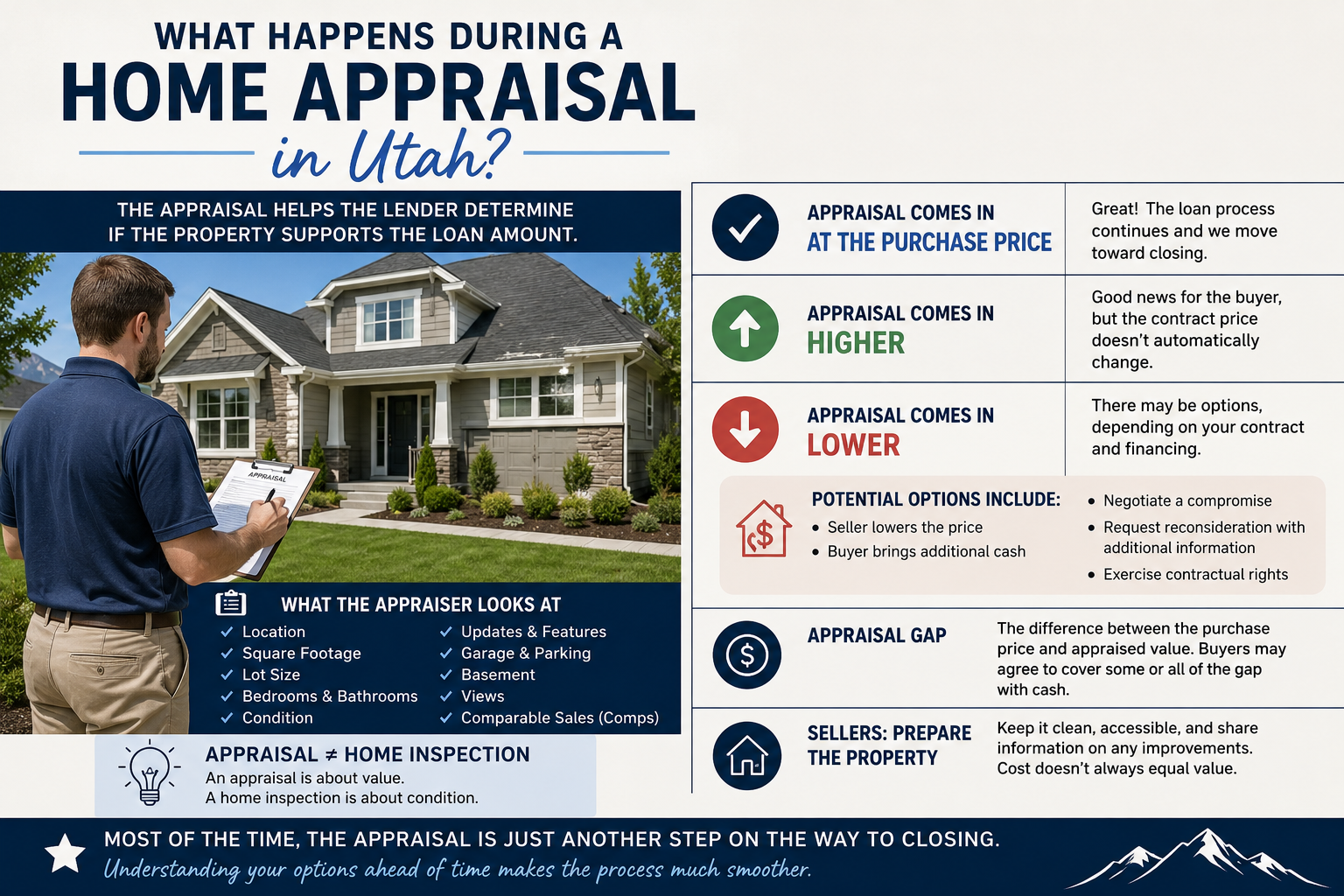
A home appraisal is an independent professional opinion of a property's value.
When a buyer is financing a home, the lender may require an appraisal before approving the loan.
The lender wants to know whether the property provides sufficient collateral for the amount being financed.
An appraisal is primarily about value.
That's different from a home inspection, which focuses much more heavily on the home's condition and potential defects.
Who Orders the Appraisal?
When financing requires an appraisal, it's generally ordered as part of the lender's loan process.
The appraiser is intended to provide an independent opinion rather than advocate for the buyer, seller or real estate agents.
The buyer commonly pays the appraisal fee as part of the costs associated with obtaining the mortgage, although the exact arrangement can vary.
What Does an Appraiser Look At?
The appraiser evaluates the property and considers characteristics that may influence its market value.
Depending on the property, this can include things such as:
- Location
- Square footage
- Lot size
- Number of bedrooms and bathrooms
- Overall condition
- Quality of construction
- Updates and improvements
- Garage and parking
- Basement characteristics
- Views
- Property features
- Comparable sales
The appraiser then uses the available information and appropriate appraisal methods to develop an opinion of value.
What Are Comparable Sales?
Comparable sales, often called "comps," are properties used to help evaluate the value of the subject home.
Ideally, these are homes that are similar in characteristics and location and that sold recently enough to provide useful market information.
Of course, no two houses are exactly the same.
One home might have a finished basement.
Another might have a larger lot.
One might have been completely renovated.
Another may be mostly original.
Appraisers can make adjustments when evaluating differences between the subject property and comparable sales.
Does the Appraiser Know the Purchase Price?
In a purchase transaction, the appraiser generally has access to information about the contract and purchase price.
But the goal isn't simply to confirm whatever amount the buyer and seller agreed upon.
The appraiser still needs to develop an independent opinion of the property's value.
Sometimes that opinion supports the purchase price.
Sometimes it doesn't.
What Happens if the Home Appraises at the Purchase Price?
If the appraisal supports the value needed for the transaction, the financing process generally continues.
The lender will still need to complete the rest of its underwriting requirements, but the appraisal itself may not require further negotiation between the buyer and seller.
For everyone involved, this is usually the least exciting appraisal outcome.
And that's a good thing.
What Happens if the Appraisal Comes in Higher?
Let's say you're under contract to purchase a home for $500,000 and the appraisal produces an opinion of value above that amount.
That doesn't automatically mean the buyer has to pay more.
The purchase price is determined by the contract.
A higher appraisal can certainly be reassuring for the buyer, but it doesn't rewrite the agreed purchase price by itself.
What Happens if the Appraisal Comes in Low?
This is the situation buyers and sellers tend to worry about.
Imagine the purchase price is $500,000, but the appraisal comes in at $480,000.
Now there is a $20,000 difference between the contract price and the appraised value.
What happens next depends on the purchase contract, financing and the terms the parties previously negotiated.
Potential options may include:
- The seller reducing the purchase price
- The buyer bringing additional cash
- The buyer and seller negotiating a compromise
- Reviewing whether the appraisal should be reconsidered based on appropriate additional information
- Exercising contractual rights when applicable
There isn't one automatic solution.
This is why understanding the appraisal provisions in your purchase contract before making an offer is so important.
Can a Buyer Pay More Than the Appraised Value?
Potentially.
A buyer may decide they're willing to purchase a property for more than the appraised value.
However, the lender generally bases its financing decisions on its applicable lending requirements rather than simply increasing the loan because the buyer agreed to a higher purchase price.
That can mean the buyer needs additional cash depending on the loan and transaction.
Before agreeing to cover an appraisal gap, buyers should understand exactly what that commitment could mean financially.
What Is an Appraisal Gap?
An appraisal gap generally refers to the difference between the agreed purchase price and the appraised value.
In competitive markets, buyers may sometimes include terms in their offer addressing how much of an appraisal shortfall they're willing to cover.
For example, a buyer might agree to cover an appraisal difference up to a specified amount.
This can potentially strengthen an offer, but it also increases the buyer's financial exposure.
Don't agree to an appraisal gap without understanding where that additional money would come from.
Can You Challenge a Low Appraisal?
There may be circumstances where additional relevant information can be submitted for reconsideration through the lender's applicable process.
For example, there may be a comparable sale or property characteristic that deserves consideration.
That doesn't mean the value will automatically change.
An appraiser isn't required to increase the value simply because the parties disagree with the result.
Your lender and real estate professional can help you understand what options are available if there appears to be relevant information that should be reviewed.
An Appraisal Is Not a Home Inspection
This distinction is extremely important.
An appraisal does not replace a home inspection.
An appraiser may observe aspects of the property's condition, and certain loan programs can have property requirements that affect financing.
But the appraisal isn't designed to provide the same detailed evaluation of the home that a professional inspection provides.
If you want to understand the condition of the roof, plumbing, electrical system, HVAC and other components, that's what your inspection and appropriate specialists are for.
What Should Sellers Do Before an Appraisal?
Sellers generally don't need to completely transform their home before the appraiser arrives.
But basic preparation can help the property present well.
Make sure the appraiser can easily access the necessary areas of the home.
Clean up obvious clutter.
Handle simple maintenance items when appropriate.
If you've made significant improvements to the property, it can also be helpful to have accurate information available regarding those updates.
Does a Renovation Add Dollar for Dollar Value?
Not necessarily.
Spending $40,000 on a renovation doesn't automatically increase the appraised value by $40,000.
Market value depends on what buyers in that particular market are willing to pay for the features and improvements.
Some renovations may contribute significantly to value.
Others may improve your enjoyment of the home without producing an equivalent increase in market value.
Cost and value aren't always the same thing.
Why the Appraisal Matters
The appraisal is one piece of a much larger transaction.
For buyers, it can affect financing and the amount of cash required to complete the purchase.
For sellers, it can influence whether the transaction moves forward at the originally agreed price.
That's why appraisal terms should be considered before the offer is accepted, not only after the appraisal report arrives.
The Appraisal Doesn't Have to Be Scary
Most of the time, the appraisal is simply another step between going under contract and getting to closing.
The important thing is understanding what could happen before you're in the middle of it.
If you're buying or selling a home in Northern Utah or anywhere along the Wasatch Front, make sure your offer strategy considers more than just the purchase price.
The financing, appraisal terms and amount of cash available can all become important before you reach the closing table.
Understanding those pieces ahead of time can make the entire process much easier to navigate.
Recent Posts