First-Time Homebuyer's Complete Guide to Northern Utah (2026 Edition)
First-Time Homebuyer's Complete Guide to Northern Utah (2026 Edition)
Everything you actually need to know — from "I think I want to buy" to keys in hand — without the jargon, the overwhelm, or the sugarcoating.
Buying your first home is one of the biggest financial decisions you'll ever make. It's also one of the most emotionally charged, logistically complex, and genuinely exciting things you'll ever do. And if you're looking at doing it in Northern Utah — across Salt Lake, Davis, Weber, Utah, Box Elder, Tooele, or Wasatch County — you're entering a market that has a lot going for it and a few things worth understanding before you dive in.
This guide exists because first-time buyers deserve better than a vague checklist or a sales pitch dressed up as advice. What you'll find here is the complete, honest picture of what it actually takes to buy your first home in Northern Utah in 2026 — the steps, the timelines, the money questions, the market realities, and the things nobody tends to tell you until you're already in the middle of it.
Grab a coffee. Let's walk through this together.
Before Anything Else: Get Your Head Around the "Why"
This sounds soft, but it's actually practical. Before you start browsing Zillow at midnight or asking friends what their mortgage payments are, spend a few minutes getting clear on why you want to buy a home and what you actually need it to do for your life.
Are you buying because you're tired of rent increases and want stability? Because you want to build equity over time? Because you need more space for a growing family? Because you want the freedom to paint the walls and get a dog without asking permission? Because Northern Utah is where you're planting roots for the foreseeable future?
All of those are good reasons. But they lead to different decisions about where to buy, what type of home makes sense, how much to spend, and how much flexibility you have on timing. Getting clear on your "why" before the process starts means you'll make better decisions at every step — especially the stressful ones.
One question worth sitting with specifically: how long do you realistically plan to stay? Northern Utah real estate, like most real estate, rewards commitment. Buyers who stay in a home for five or more years consistently come out ahead. Buyers who sell after two years often break even at best, depending on timing and transaction costs. If your five-year plan has major uncertainty in it — a possible job relocation, a relationship situation in flux, a career change that might take you somewhere else — that's important context for deciding whether now is the right time to buy at all.
If you're confident about staying, keep reading. This guide is for you.
Step One: Understand What You Can Actually Afford
Not what a mortgage calculator says. Not what your lender will technically approve you for. What you can actually, comfortably afford to spend every month on housing — including everything that comes with owning a home, not just the mortgage payment itself.
This is where a lot of first-time buyers get into trouble. They focus entirely on the purchase price and the monthly mortgage number, and then they move in and discover that homeownership comes with a set of ongoing costs that renting insulated them from completely.
Here's what the real monthly cost of owning a home in Northern Utah looks like:
Principal and interest — the base mortgage payment that everyone thinks about. This varies based on your purchase price, down payment, and interest rate.
Property taxes — in Utah, property taxes vary by county and by the assessed value of your home. As a rough planning number, Northern Utah homeowners typically pay somewhere between 0.5% and 0.7% of their home's value annually in property taxes, though this varies. On a $400,000 home, that's roughly $2,000 to $2,800 per year, or $165 to $235 per month added to your payment.
Homeowner's insurance — typically $100 to $150 per month for a standard single-family home in Northern Utah, though this varies based on the home, its age, and your coverage levels.
Private mortgage insurance (PMI) — if your down payment is less than 20%, your lender will require PMI, which typically runs between 0.5% and 1.5% of your loan amount annually. On a $380,000 loan, that's roughly $160 to $475 per month. It's not forever — PMI drops off once you've built 20% equity — but it's a real cost to plan for.
HOA fees — many Northern Utah communities, particularly newer developments in the south Salt Lake County suburbs, Davis County, and parts of Utah County, have homeowner associations with monthly fees ranging from $50 to well over $200. Not every home has an HOA, but if you're looking at townhomes, condos, or planned communities, factor this in.
Maintenance and repairs — this is the one renters are least prepared for. A general rule of thumb is to budget 1% of your home's value per year for maintenance. On a $400,000 home, that's $4,000 annually, or about $333 per month set aside. You won't spend it every month, but when the furnace goes out or the roof needs attention, you'll be very glad you planned for it.
Add all of that up and the real monthly cost of homeownership is meaningfully higher than the mortgage payment alone. Make sure your budget accounts for the full picture — not just the number your lender approves.
A practical rule: most financial advisors suggest keeping your total housing costs at or below 28% to 30% of your gross monthly income. Use that as your ceiling, not your target.
Step Two: Know Your Down Payment Options (There Are More Than You Think)
The 20% down payment myth has been scaring off first-time buyers for decades. Let's put it to rest right now.
You do not need 20% down to buy a home in Northern Utah. Many first-time buyers put down significantly less. Here are the real options:
Conventional loans with 3% to 5% down — yes, conventional loans — not just government-backed programs — are available with as little as 3% down for first-time buyers through programs like Fannie Mae's HomeReady and Freddie Mac's Home Possible. These do come with PMI until you hit 20% equity, but they're a legitimate path into homeownership without years of additional saving.
FHA loans with 3.5% down — Federal Housing Administration loans are one of the most common pathways for first-time buyers. With a credit score of 580 or above, you can qualify for 3.5% down. FHA loans are more forgiving on credit history than conventional options and have competitive rates. The trade-off is that FHA mortgage insurance has different rules than conventional PMI — it lasts longer in many cases — so understand the full picture before choosing this route.
VA loans with 0% down — if you're a veteran or active-duty service member, the VA loan program is one of the most powerful financial tools available to you. No down payment, no PMI, and competitive rates. Northern Utah has a significant military community, and the VA loan is genuinely underutilized by buyers who qualify for it.
USDA loans with 0% down — the USDA Rural Development loan program is available for homes in eligible rural and suburban areas. Parts of Box Elder County, Tooele County, and Wasatch County may qualify. If you're considering those markets, it's worth checking USDA eligibility for specific properties.
Utah Housing Corporation programs — the Utah Housing Corporation offers down payment assistance programs specifically designed for Utah buyers, including first-time homebuyers. These programs can provide down payment and closing cost assistance in the form of second loans with low or deferred interest. Income limits apply, and the programs have specific requirements, but for buyers who qualify, they can be the difference between buying now and waiting another two or three years.
The bottom line on down payments: more is generally better, because a larger down payment means a lower monthly payment, no PMI or faster PMI removal, and more equity from day one. But "more is better" doesn't mean "less isn't enough to get started." Figure out what you have, understand your options, and make the decision that fits your actual situation.
Step Three: Get Pre-Approved Before You Fall in Love With Any House
This is non-negotiable in Northern Utah's market, and it's one of the most common mistakes first-time buyers make — falling in love with a home before they know what they can actually borrow.
Pre-approval is not the same as pre-qualification. Pre-qualification is a quick, surface-level estimate based on information you provide verbally or online. Pre-approval is an actual review of your financial documents — pay stubs, tax returns, bank statements, credit report — by a lender who then issues a letter stating they are conditionally willing to lend you a specific amount.
Sellers in Northern Utah take pre-approval seriously. In competitive markets and on desirable properties, offers without a pre-approval letter are frequently ignored entirely. Getting pre-approved before you start seriously shopping isn't just helpful — it's the price of admission.
Here's what you'll need to gather for a pre-approval:
Two years of tax returns and W-2s. Recent pay stubs — typically the last 30 days. Two to three months of bank statements for all accounts. A list of your debts and monthly obligations. Your Social Security number so the lender can pull your credit.
The pre-approval process will also surface any credit issues that need to be addressed before you can qualify. If your credit score needs work, better to know that now than four weeks into a home search when you thought you were ready to make an offer.
One important note: get pre-approved but don't make any major financial moves until after you close on your home. Don't open new credit cards. Don't buy a car. Don't change jobs if you can help it. Don't make large unexplained deposits into your bank accounts. Lenders re-verify your financial situation right before closing, and changes that happen between pre-approval and closing can — and do — cause deals to fall apart.
Step Four: Find the Right Agent — and Understand What They Actually Do for You
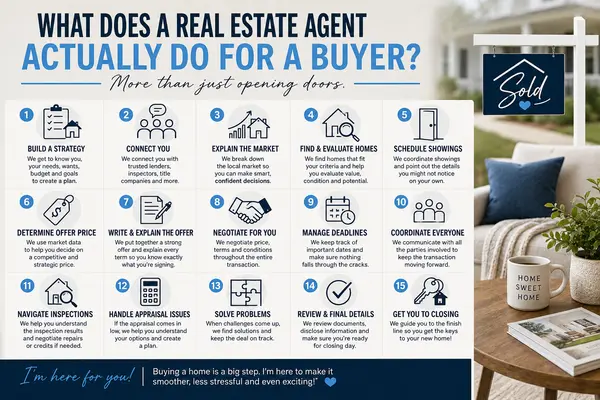
As a first-time buyer in Northern Utah, working with a good buyer's agent is one of the highest-value decisions you'll make in this process. And in most transactions, the seller pays the buyer's agent's commission, which means you get professional representation at no direct cost to you.
Here's what a good buyer's agent actually does that matters:
They know the specific sub-markets across Northern Utah and can give you an honest read on whether a price is fair, whether a neighborhood is a good fit, and whether a home has issues worth paying attention to before you fall in love with it.
They protect your interests in negotiation. This is enormous. A buyer who makes an offer without representation is negotiating against a listing agent whose fiduciary duty is to the seller. Having an agent in your corner who is legally obligated to represent your interests changes that dynamic entirely.
They know the paperwork — the Utah Real Estate Purchase Contract is a specific, detailed document with timelines, contingencies, and provisions that carry real financial consequences if you misunderstand or miss them. Having someone who reads these contracts every week guide you through it is genuinely valuable.
They have relationships and resources. When the inspection comes back with concerns, your agent knows contractors who can give you accurate repair estimates so you know whether to negotiate, walk away, or proceed. When you're trying to understand closing costs, they can help you get competitive quotes from title companies and lenders. When you need information quickly, they can get it.
What to look for when choosing a buyer's agent in Northern Utah: local knowledge of the specific counties and communities you're considering, a track record of working with first-time buyers, and a communication style that matches yours. You're going to be working closely with this person through one of the most stressful processes of your life — make sure you trust them and feel comfortable asking what might feel like dumb questions. There are no dumb questions when you're buying your first home.
Step Five: Know the Northern Utah Market You're Buying Into
Northern Utah is not one market. It's seven counties with distinct personalities, price points, and market dynamics. Here's a quick honest snapshot of what first-time buyers encounter in each:
Salt Lake County is the largest and most competitive market in the region. Entry-level inventory has been tight as prices have risen, but mid-valley communities like West Valley City, Taylorsville, and Murray offer more accessible price points. Expect competition on well-priced homes and move quickly when you find something you like.
Davis County is one of the most family-friendly markets in Northern Utah with excellent schools, strong community infrastructure, and a wide range of price points from Bountiful in the south to Layton and Clearfield further north. Generally slightly more accessible than Salt Lake County while still offering easy Wasatch Front access.
Weber County is where first-time buyers who have done their homework are increasingly landing. Ogden and its surrounding communities offer genuine value — more home for the money, great outdoor access, and a market that's appreciated meaningfully without becoming inaccessible. Historic 25th Street and surrounding neighborhoods are worth serious attention.
Utah County encompasses Provo, Orem, Lehi, and a rapidly growing tech corridor that has brought significant employment and population growth. Strong demand from a large university population and tech sector employees keeps competition active. Lehi and Saratoga Springs in the county's north end have seen significant new construction activity.
Box Elder County — Brigham City and Tremonton — offers Northern Utah's most accessible price points for buyers willing to accept a longer commute. A genuine option for buyers who want more home and more space than their budget allows closer to Salt Lake.
Tooele County sits west of Salt Lake County and has been growing steadily as buyers priced out of the Salt Lake suburbs look for alternatives. Stansbury Park and Tooele City offer real value at prices that make first-time buying financially realistic.
Wasatch County — Heber City and the Heber Valley — is a premium market driven by its mountain lifestyle, proximity to Park City, and four-season outdoor access. Entry-level options exist but are limited. Worth exploring for buyers who specifically value that lifestyle and have the budget to support it.
Step Six: The Home Search — What to Expect and How to Stay Sane
Here's the honest truth about home searching in Northern Utah in 2026: it takes longer than most first-time buyers expect, it's more emotionally demanding than they anticipate, and it almost always involves at least one offer that doesn't work out before you get to the one that does.
That's not a reason to be discouraged. It's a reason to go in with realistic expectations so you don't get rattled when the process gets bumpy.
A few things that will help you search smarter:
Get clear on your non-negotiables versus your nice-to-haves before you start. Number of bedrooms, school district, garage, maximum commute — these are things you filter by. Granite countertops, a specific paint color, a certain backyard size — these are things you can work with or change. Know the difference before you start, because in the heat of a home search, it's easy to confuse them.
Don't ignore homes that need cosmetic work. In Northern Utah's market, move-in-ready homes at entry-level price points get the most competition. Homes that need fresh paint, updated flooring, or a kitchen that's five years behind the design trends often sit longer and sell for less — and most of those things are fixable with time, budget, and a little patience. Don't let cosmetic issues disqualify a home with good bones in a good location.
Pay attention to the neighborhood, not just the house. You can renovate a kitchen. You cannot renovate the street, the school district, or the neighbors. When you're evaluating a home, drive the neighborhood at different times of day. Walk to the places you'd walk to regularly. Think about what daily life actually feels like from that address — not just what the interior looks like in listing photos.
Set up automated alerts. In active sub-markets across Northern Utah, good homes at entry-level price points can go from listed to under contract in days. Make sure your agent has you set up with real-time alerts so you're not discovering homes twenty-four hours after everyone else already knows about them.
Stay in your lane financially. It's easy to start shopping slightly above your budget "just to see" and then find yourself anchored to homes you can't comfortably afford. Do your viewing at and below your pre-approved amount, not above it.
Step Seven: Making an Offer — What Actually Goes Into It
When you find the right home, you'll need to move from "I love this" to "here's our offer" faster than feels comfortable the first time. Here's what goes into an offer in Northern Utah:
Purchase price — what you're offering to pay. This should be informed by your agent's analysis of comparable recent sales in the area, the home's condition, and how competitive the current market is for that property.
Earnest money deposit — a good-faith deposit that shows the seller you're serious. In Northern Utah, earnest money typically ranges from 1% to 3% of the purchase price. This money goes toward your down payment at closing and is at risk if you back out of the contract without a legitimate contingency to protect you.
Financing contingency — protects you if your loan doesn't come through. This is standard and you should not waive it without understanding exactly what you're giving up.
Inspection contingency — gives you the right to have the home professionally inspected and to negotiate repairs, request a price reduction, or walk away if serious issues are discovered. Do not waive your inspection. Full stop. In Northern Utah's current market, you generally do not need to waive it to be competitive on most homes.
Appraisal contingency — protects you if the home appraises for less than the purchase price, which would affect your financing. Understand this contingency and talk to your agent about how to handle it in the current market.
Closing date — when you want to take possession. Sellers have preferences here too, and being flexible on closing date can sometimes make your offer more attractive without costing you anything.
Your agent will walk you through all of this in real time when you're ready to make an offer. The important thing is to understand the framework before you're in the moment so you can make clear-headed decisions rather than reactive ones.
Step Eight: Inspections, Appraisals, and the Final Stretch
Your offer was accepted. Take a breath. Then get ready for the next phase — because there's still work to do between accepted offer and closed transaction.
The home inspection happens early in the contract period — typically within the first 10 to 14 days in Utah. Hire a licensed home inspector (your agent can recommend several) and attend the inspection in person. This is your chance to understand the home you're buying at a deep level. No home is perfect. Every inspection comes back with a list of items, ranging from minor maintenance recommendations to significant deficiencies. The question is not "is the list long?" — it's "are there anything on this list that changes my decision or my price?"
After the inspection, you have options. You can request that the seller repair specific items before closing. You can ask for a price reduction in lieu of repairs. You can ask for closing cost credits. Or you can accept the home as-is if the inspection didn't surface anything that changes your view of the value. Your agent will help you think through the negotiation strategy based on what the inspection found and what the market conditions look like.
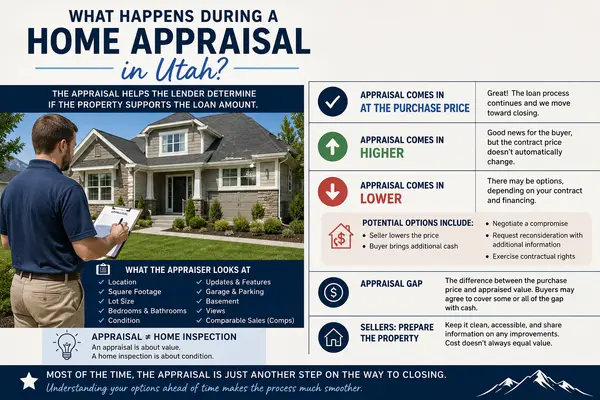
The appraisal is ordered by your lender and completed by an independent licensed appraiser who confirms that the home is worth at least what you're paying for it. If it appraises at or above your purchase price, you're clear to proceed. If it comes in low, you have a conversation to have — with the seller, with your lender, and with your agent — about how to bridge the gap or whether to proceed at all.
The final walkthrough happens shortly before closing — typically the day before or the morning of. This is your chance to confirm that the home is in the same condition as when you made your offer, that any agreed-upon repairs have been completed, and that nothing has changed. Don't skip it.
Closing is where the transaction completes. You'll sign a significant stack of documents — your loan paperwork, the deed transfer, and various disclosures — and you'll bring your closing funds (typically via wire transfer). Once everything is signed and funds are disbursed, you get the keys. That's it. You're a homeowner.
The Costs You Need to Plan for Beyond the Down Payment
First-time buyers sometimes arrive at closing surprised by the total amount of cash they need. Here's the full picture so you're not surprised.
Closing costs — the fees associated with completing the transaction. In Northern Utah, buyers typically pay between 2% and 4% of the purchase price in closing costs. On a $400,000 home, that's $8,000 to $16,000. Closing costs include lender fees, title insurance, escrow fees, recording fees, prepaid property taxes, and prepaid homeowner's insurance, among other items. Some of these can be negotiated — sellers sometimes contribute toward buyer closing costs as part of the deal, and shopping around for title and escrow services can make a real difference.
Home inspection fee — typically $350 to $600 for a standard single-family home in Northern Utah, paid directly to the inspector.
Appraisal fee — typically $500 to $700, often paid upfront or rolled into closing costs depending on your lender.
Moving costs — frequently overlooked until the last minute. Budget realistically for your actual move, whether that's a moving company, truck rental, or help from very generous friends.
Immediate home needs — almost every new homeowner has a list of things they want to do or need to do in the first few weeks. New locks are a good idea. Paint if the previous owners had interesting taste. Appliances if they didn't convey with the sale. Have a budget for the immediate setup period so you're not financially depleted right after closing.
The Things Nobody Tells You (But We Will)
A few honest insights from working with first-time buyers in Northern Utah that don't fit neatly into any of the steps above:
The emotional rollercoaster is real and normal. Buying your first home involves excitement, anxiety, doubt, relief, more doubt, and eventually — when you get the keys — a kind of joy that's hard to describe to someone who hasn't been through it. All of those feelings are normal. The buyers who handle the process best are the ones who expect the emotional swings rather than being blindsided by them.
Your first home is not your forever home. A lot of first-time buyers put enormous pressure on themselves to find the perfect home — the one that checks every box and serves every need for the rest of their lives. That's not how it works for most people. Your first home is a financial step, a place to build equity, a home that fits your life right now. It doesn't need to be the last home you ever buy. Releasing that pressure often makes the search significantly easier.
The market will always look uncertain from the outside. There will never be a moment when every headline says "now is obviously the perfect time to buy." There will always be reasons to wait — rates, prices, political uncertainty, economic headlines. The buyers who build wealth through real estate are the ones who make informed, thoughtful decisions based on their own circumstances rather than waiting for a certainty that never arrives.
Your agent is your greatest asset in this process. Not Zillow. Not Reddit. Not your cousin who bought a house in a different state eight years ago. A local agent who knows Northern Utah's specific markets, who has been through this process hundreds of times, and who is legally obligated to represent your interests is genuinely your most valuable resource. Use them accordingly.
A Quick Timeline: What to Expect from Start to Keys
For first-time buyers trying to wrap their heads around how long this all takes, here's a realistic Northern Utah timeline:
Months 1 to 2 — financial foundation. Review your credit, start saving aggressively for down payment and closing costs, research down payment assistance programs, and get a referral for a lender.
Month 2 to 3 — get pre-approved. Gather your documents, meet with a lender, and get a formal pre-approval letter.
Month 3 onward — connect with your buyer's agent, define your search criteria, and begin actively viewing homes.
Variable: the home search itself — this can take anywhere from two weeks to six months or more depending on your market, your criteria, your budget, and your flexibility. Set realistic expectations and don't panic if it takes longer than you hoped.
Accepted offer to close — once your offer is accepted, the typical transaction in Northern Utah takes 30 to 45 days to close, depending on your loan type and the terms of your contract. FHA and VA loans sometimes take a bit longer than conventional loans due to additional appraisal requirements.
Total from "I think I want to buy" to keys — realistically, plan for three to six months as a first-time buyer if you're starting from scratch. It can happen faster for buyers who are financially ready and flexible. It takes longer for buyers who need time to build their down payment or work through credit issues first.
You Don't Have to Figure This Out Alone
Buying your first home in Northern Utah is a big deal. It's one of the most significant financial decisions you'll make in your life, and there's a lot to understand, navigate, and get right. But it's also completely doable — buyers do it every single day across all seven Northern Utah counties, at a wide range of budgets and circumstances.
The key is having the right information and the right team in your corner.
Ready to Start? The Real Estate Group Is Here.
The Graham Allen Group works with first-time buyers across all of Northern Utah — Salt Lake, Davis, Weber, Utah, Box Elder, Tooele, and Wasatch counties. We've helped hundreds of first-timers go from "I think I want to buy" to standing in their own home with keys in hand, and we'd love to do the same for you.
We'll walk you through where you are today, what you need to get ready, what the market looks like in the areas you're considering, and what a realistic path to homeownership looks like for your specific situation. No pressure. No sales pitch. Just honest guidance from people who know these markets inside and out.
Reach out to the Graham Allen Group today to schedule your free first-time buyer consultation. It's the best first step you can take — and we'll be with you every step after that.
Recent Posts